

The Complete Guide to Indian Bridal Jewellery Sets in 2026: Kundan, Polki, Temple, Choker and Modern Styles
By Aditi Sharma, Editor, Bridal & Ethnic Fashion at Dyulokha
An Indian bridal jewellery set is a coordinated collection of pieces worn by a bride, traditionally including a necklace or haar, matching earrings (often jhumkas or chandbalis), maang tikka or mathapatti, nath (nose ring), kada or bangles, and often a choker or rani haar layered together. Regional traditions vary significantly. South Indian brides favour temple jewellery in gold with kasu (coin) work. North Indian brides gravitate to kundan and polki sets in Mughal-inspired designs. Bengali brides wear shakha pola and a mukut. Marathi and Gujarati brides carry region-specific heritage pieces. Modern brides increasingly mix heritage styles with contemporary settings. Prices span a very wide range, from ₹5,000 for fashion bridal sets to over ₹1,50,000 for premium polki and heritage-grade pieces in the D-Luxe tier. This guide covers every major bridal jewellery style, regional traditions, materials, ceremonial pairings, budget tiers, and 2026 styling directions. The bridal jewellery sets featured on Dyulokha are curated across trusted jewellery brands, master craftsmen, and specialist ateliers working in Jaipur, Delhi, Chennai, Hyderabad, and Kolkata.
What is a bridal jewellery set?
An Indian bridal jewellery set is not a single piece. It is a full ensemble worn together on the wedding day and across pre-wedding functions, designed to complement the bride's outfit and communicate cultural and regional identity.
The traditional Indian bridal look is built around the concept of solah shringar, sixteen adornments a bride wears from head to toe. While not every bride wears all sixteen, the concept still shapes what a bridal jewellery set includes.
The core components of a modern bridal jewellery set:
Necklace or haar. The centrepiece. Options range from a short choker sitting high on the neck, to a mid-length princess necklace, to a full-length rani haar reaching the waist. Bridal brides often layer two or three necklaces at different lengths for a heavy bridal look.
Earrings. Traditionally jhumkas (dome-shaped bell earrings) or chandbalis (crescent-shaped drop earrings) for a full bridal look. Studs and modern drop earrings are chosen for reception and lighter wedding functions.
Maang tikka or mathapatti. The maang tikka is a single pendant that sits at the centre parting of the hair, connected by a chain to a hair pin. The mathapatti is an elaborate head chain that extends across the forehead and hairline, worn for heavier bridal looks.
Nath. A nose ring, usually a large hoop nath for the wedding day (Maharashtrian brides wear a distinct paisley-shaped nath). Smaller nose studs are worn for other functions.
Bangles and kada. Traditional bridal looks feature stacks of bangles, often including a heavy central kada with kundan or polki work, flanked by matching thinner bangles. Punjabi brides wear the chooda, a set of red and white bangles.
Additional pieces. Depending on tradition and outfit, brides may add a kamarband (waist belt), anklets (payal), hip chain, bajubandh (armlet), passa (side head ornament), or braid pins.
The pieces work together as a coordinated set, which is why bridal jewellery is usually purchased or commissioned as a matched ensemble rather than piece by piece.
Regional traditions in Indian bridal jewellery
Indian bridal jewellery is deeply regional. What a Tamil bride wears is fundamentally different from what a Punjabi or Bengali bride wears. Understanding regional traditions helps a bride honour her heritage or intentionally cross traditions.
South Indian bridal jewellery
South Indian bridal jewellery is dominated by temple jewellery, a style rooted in the ornaments worn by temple deities across Tamil Nadu, Andhra Pradesh, Karnataka, and Kerala. Temple jewellery features motifs of deities, temple architecture, peacocks, mangoes, and lakshmi coins (kasu).
The classic South Indian bridal ensemble includes a heavy temple necklace or kasu mala (coin necklace), a matching mango mala (paisley-shaped pendant chain), a vaddanam or hip belt, temple jhumkas, a jimikki (traditional earring), heavy bangles, and a distinctive nethi chutti which is a South Indian mathapatti with sun and moon motifs on either side of the parting.
Tamil, Telugu, and Kannadiga brides typically pair this with a bridal Kanjivaram silk saree. Malayali brides traditionally wear a Kasavu saree with lighter gold work. South Indian bridal jewellery skews yellow-gold-toned, with heavy use of pearls, rubies, emeralds, and coral in the traditional palette.
North Indian bridal jewellery
North Indian bridal jewellery is dominated by kundan and polki work, styles rooted in the Mughal court craftsmanship of Rajasthan and Delhi. The traditional North Indian bridal ensemble includes a heavy kundan or polki necklace often layered with a choker underneath, matching chandbali earrings, a maang tikka or a full mathapatti, a nath connected by a chain to the ear, kada bangles, a bajubandh, and a kamarband.
Punjabi, Rajasthani, Uttar Pradesh, and Bihari brides typically pair this with a heavy lehenga in bridal red, maroon, or deep pink. Punjabi brides additionally wear the chooda, a set of red and white bangles worn for weeks after the wedding, and kalire, decorative hangings tied to the bangles.
Bengali bridal jewellery
Bengali bridal jewellery has its own distinct language. Bengali brides traditionally wear shakha pola, a pair of white shell and red coral bangles, along with loha badhano, an iron bangle covered in gold. The signature piece is the mukut, a paper or fabric crown worn on the wedding day. Necklaces feature the sitahaar, a long multi-layered necklace, along with a ratanchur, a hand ornament connecting the ring to the bracelet. Bengali bridal jewellery skews to intricate yellow gold work, often filigreed and lightweight.
Maharashtrian bridal jewellery
Maharashtrian bridal jewellery is defined by the paisley-shaped nath, considered the most important piece for a Marathi bride. Other signature pieces include the kolhapuri saaz (a distinctive necklace with leaf-shaped pendants), the thushi (a choker of tightly-woven gold beads), the chinchpeti (a shorter choker), vaaki (an armlet), and mundavalya (pearl strings tied across the forehead and cheeks during the ceremony). Marathi brides traditionally wear a Paithani silk saree with this ensemble.
Gujarati and Rajasthani bridal jewellery
Gujarati brides wear a distinctive damni (a decorative headpiece), a heavy choker called the chandanhaar, and colourful meenakari-worked pieces that pair with the vivid bandhani or gharchola bridal saree. Rajasthani brides wear the rakhdi (a large maang tikka), a borla (round pendant maang tikka), the aad (a wide choker), and elaborate kundan and polki work characteristic of the Jaipur ateliers.
Pakistani bridal jewellery
Pakistani bridal jewellery draws from the same Mughal tradition as North Indian bridal ensembles, favouring polki, kundan, and jadau work. The Pakistani bridal ensemble typically includes a matha patti, a heavy necklace layered with a choker, jhumka earrings, a large nath connected to the ear, and multiple bangles. Pakistani bridal styling often features heavier gold-toned pieces with detailed jadau work, and pairs with elaborate embroidered lehengas or gharara sets.
The main styles of bridal jewellery sets
The style refers to the craftsmanship technique used to make the piece. Understanding these styles helps a bride pick jewellery that matches her outfit, budget, and aesthetic.
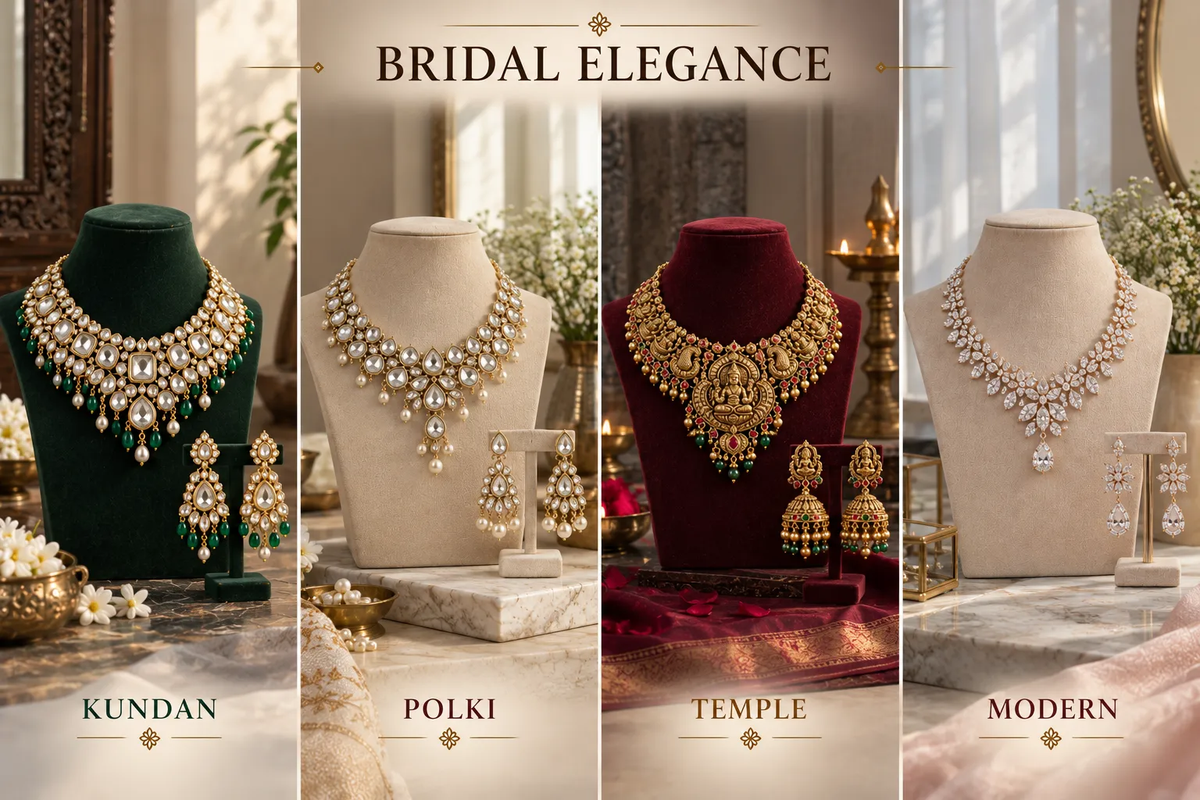
Kundan bridal sets
Kundan is one of the oldest gemstone-setting techniques in India, dating to the Mughal courts of Rajasthan. The traditional kundan technique layers 24-karat gold foil around a stone (glass, uncut gemstone, or paste), which is then set into a base of lac (natural resin). The result is a piece with a distinctive high-shine gold border framing each stone.
Kundan bridal sets typically feature bold, colourful stones (red, green, blue, white) set in gold frames, with pearl droplets hanging from the edges. The style is heavy, ornate, and photographs beautifully in wedding lighting.
Fashion-grade kundan sets on marketplaces including Dyulokha use gold-plated metal settings with high-quality glass or resin stones, offering the same visual impact at a fraction of the heritage price. Prices for fashion kundan bridal sets range from ₹8,000 to ₹60,000, while heritage handcrafted kundan sets from named Jaipur ateliers can range from ₹1,50,000 to ₹15,00,000 and above.
Explore the kundan bridal jewellery collection.
Polki bridal sets
Polki is a style that uses uncut, unpolished diamonds or diamond-like stones set in gold. Traditional polki uses natural uncut diamonds set in 22-karat gold. Fashion-grade polki uses high-quality uncut stones (natural, lab-grown, or crystalline glass) set in gold-plated silver or base metal.
Polki bridal sets are traditionally heavier, more ornate, and more valuable than kundan sets, since the stones retain their natural diamond form. The finish has a slightly softer, more antique glow compared to the high-shine of kundan.
Polki has become the leading bridal style across North India, particularly for the wedding day itself. Fashion polki bridal sets on Dyulokha range from ₹15,000 to ₹80,000, while premium and heritage-grade polki sets in the D-Luxe tier extend well above.
Explore the polki bridal jewellery collection and the D-Luxe bridal series.
Meenakari bridal sets
Meenakari is the art of enamelling metal surfaces with vibrant colours, giving the reverse side of jewellery a painted, colourful finish. In bridal jewellery, meenakari appears on the back of kundan and polki pieces, giving the jewellery visual richness on both sides. High-end bridal pieces feature meenakari in traditional palettes of red, green, blue, and white.
Jadau bridal sets
Jadau is a technique closely related to kundan and polki, where uncut stones are pushed into molten gold and held in place as the gold cools. Jadau is often used for the heaviest, most heritage-grade bridal pieces, and the term is used interchangeably with polki in many contexts.
Temple jewellery bridal sets
Temple jewellery refers to South Indian gold jewellery designed with temple architecture and deity motifs. Traditional temple jewellery is crafted in 22-karat gold with pearls, rubies, emeralds, and coral, and is often commissioned as heirloom pieces. Fashion-grade temple jewellery uses gold-plated silver or base metal with imitation stones, replicating the traditional look at accessible prices.
Temple jewellery bridal sets range from ₹6,000 for lighter fashion sets to ₹80,000 for heavier premium pieces, with heritage 22-karat gold temple sets reaching lakhs.
Explore the temple jewellery collection.
Modern and fusion bridal sets
Contemporary bridal jewellery in 2026 increasingly blends traditional Indian techniques with modern silhouettes. This includes minimalist polki chokers, contemporary temple jewellery redesigned for reception wear, geometric kundan layering pieces, and mixed-metal (silver and gold-plated) fusion sets. Fusion bridal sets suit brides who want a lighter look for engagement, sangeet, or reception, and who plan to re-wear pieces post-wedding.
Understanding materials: gold-plated, gold-finish, silver, and imitation jewellery
This is one of the most important sections for a first-time bridal jewellery buyer. Being clear about materials protects you from overpaying and from mismatched expectations.
Solid gold heritage jewellery is made from 22-karat or 24-karat gold and is priced by gold weight, which fluctuates daily with commodity markets. A solid gold bridal set of moderate weight typically starts at ₹3,00,000 and can extend to ₹50,00,000 or more for a heritage-grade full ensemble. Solid gold heritage pieces are typically commissioned directly from named jewellery houses (Tanishq, Kalyan, Malabar, PC Jeweller, and heritage ateliers) and are not stocked on fashion marketplaces.
Gold-plated fashion jewellery is the category that dominates online bridal jewellery marketplaces including Dyulokha. Gold-plated jewellery is made from a base metal (usually brass, copper, or silver) that has been coated with a thin layer of gold, giving the visual look of gold at a fraction of the price. Quality varies: micro-plating (0.5 microns) will wear off within months; 1-3 micron plating lasts several years with proper care; heavy plating (5+ microns) can last a decade or more.
Silver bridal jewellery is made from sterling silver (92.5% silver) and is priced by silver weight plus craftsmanship. Silver bridal sets are increasingly popular for reception, sangeet, and lighter wedding functions, and often feature oxidised finishes, kundan work in silver settings, or temple designs in silver. Silver bridal pieces range from ₹4,000 to ₹80,000 depending on weight and detailing.
Kundan and polki settings in the fashion tier use gold-plated silver or gold-plated base metal, with glass, resin, or synthetic stones. Traditional kundan uses 24k gold foil with natural stones. When a marketplace lists a kundan set at ₹15,000, it is fashion-grade with plating and imitation stones. When it lists at ₹1,50,000, it may be heritage-grade with silver base and real semi-precious stones. Above ₹5,00,000, the piece may involve real gold and natural uncut diamonds.
Most bridal sets on Dyulokha are fashion jewellery, expertly finished in gold-plating, silver, or oxidised metal, with kundan, polki, meenakari, or pearl detailing designed to give the visual impact of heritage jewellery at accessible prices. Solid gold heirloom pieces are a separate market segment.
Being clear about what you are buying protects you from disappointment. A ₹20,000 bridal set is a beautifully crafted fashion piece, not a family heirloom. Both have their place in the bridal wardrobe.
How to choose bridal jewellery by ceremony
Different wedding functions call for different jewellery weights and styles. Most brides plan a jewellery wardrobe across the full week.
Engagement and roka
For the engagement or roka ceremony, brides typically choose a lighter set. A polki or kundan choker with matching earrings, a delicate maang tikka, and light bangles work well. The look should feel celebratory but not full-bridal. Silver-based fusion sets and lighter gold-plated pieces are popular here. Budget: ₹8,000 to ₹40,000 for the full look.
Sangeet
Sangeet is the pre-wedding music and dance night. Bridal jewellery here should be beautiful but lightweight enough to dance in. Modern polki chokers, statement earrings, delicate mathapatti, and a few statement bangles work well. Contemporary and fusion pieces suit sangeet better than heavy heritage jewellery. Budget: ₹10,000 to ₹50,000.
Mehendi and haldi
Mehendi and haldi functions are traditionally low-jewellery events. Brides wear light floral jewellery (real jasmine or artificial flower jewellery), simple studs, a single-strand chain, and light bangles. Heavy jewellery is avoided since haldi (turmeric) can stain metal. Budget: ₹3,000 to ₹15,000, plus optional floral jewellery.
Explore Dyulokha's mehendi collection and haldi collection.
Wedding day
The wedding day itself is the peak jewellery moment. The full bridal ensemble is worn: a heavy layered necklace (often two or three necklaces stacked), a full mathapatti or heavy maang tikka, chandbali or heavy jhumka earrings, a nath connected to the hair, stacked bangles with a central kada, and additional pieces including a kamarband, bajubandh, and anklets depending on tradition. This is where the D-Luxe and premium polki bridal sets shine. Budget: ₹40,000 to ₹1,50,000 for premium fashion bridal sets, extending to lakhs for heritage-grade pieces.
Explore the bridal jewellery collection and wedding occasion collection.
Reception
The reception typically calls for a shift from traditional to contemporary. Brides often choose a modern polki necklace with matching earrings, a lighter mathapatti or no head jewellery at all, delicate bangles, and possibly a statement cocktail ring. Silver-based, pearl, and modern fusion pieces suit reception looks. Budget: ₹15,000 to ₹60,000.
Matching bridal jewellery to your outfit
The jewellery has to work with the outfit. Here is how to think through the pairing.
Match the metal tone to the outfit's embroidery. If your lehenga or saree has gold zari, choose gold-plated jewellery. If it has silver zari or sequin work, silver bridal jewellery reads better. Rose gold works with peach, blush, and pastel outfits.
Consider the necklace length against your neckline. A high-neck or closed-neck blouse pairs with a longer necklace or rani haar sitting below the neckline. A deep or sweetheart neckline calls for a choker sitting close to the neck, or a two-piece layered look with a choker plus a longer haar.
Balance the weight visually. A heavy, heavily-embroidered lehenga calls for heavy jewellery to balance. A lighter, simpler outfit is elevated by heavy statement jewellery. Two heavy statement elements in the same look (a fully embroidered lehenga plus a heavy full-bridal jewellery set) is the traditional bridal choice for the wedding day. For lighter functions, keep either the outfit or the jewellery as the statement, not both.
Colour matching. For a red bridal outfit, kundan or polki with green, white, or gold stones works beautifully. Green outfits pair with kundan featuring red or white stones. Pastel outfits pair with polki or diamond-look pieces in silver or rose gold settings. Bold colour outfits (magenta, teal) work with contrast-coloured meenakari or a monochrome piece that ties in a single accent from the outfit.
Read more in our Bridal Choker Necklace Guide 2026 for high-neckline pairing tips.
Bridal jewellery by budget
Budget is a real conversation. Here is what to expect at each tier.
₹5,000 to ₹15,000: Fashion bridal sets. Gold-plated base metal with imitation stones. Suitable for engagement, sangeet, reception, and for guests attending a wedding. Good quality plating and craftsmanship at this tier can look striking in photographs, but pieces need careful care to keep the plating intact.
₹15,000 to ₹50,000: Mid-tier gold-plated bridal sets with quality stones. Better plating (2-3 microns), higher-quality glass or crystal stones, more detailed craftsmanship, and heavier construction. Suitable for a full bridal look at the wedding day for brides who want a beautiful ensemble without heritage-grade investment.
₹50,000 to ₹1,50,000: Premium polki, kundan, and D-Luxe tier. This is where you find the heaviest fashion bridal pieces with the best plating (5+ microns), high-grade uncut stones, meenakari back-work, and detailed jadau craftsmanship. The D-Luxe bridal series on Dyulokha sits in this tier, curated across premium bridal jewellery brands and specialist ateliers. Also suitable for silver-based heritage-style pieces with kundan and polki work.
₹1,50,000 to ₹5,00,000: Heritage-grade bridal jewellery. Semi-precious real stones, sterling silver bases with heavy gold plating, and named atelier work. This tier borders on real gold heritage jewellery.
Above ₹5,00,000: Solid gold and real diamond bridal jewellery. Full 22-karat gold heritage sets, real polki with natural uncut diamonds, and heirloom-grade pieces. Typically commissioned directly from named jewellery houses.
Most brides in 2026 build their wedding jewellery wardrobe across tiers: a mid-tier set for engagement and reception, and a premium or D-Luxe set for the wedding day.
Bridal jewellery trends in 2026
The 2026 bridal jewellery market shows several distinct movements.
Chokers are the defining piece of the year. Layered choker-plus-long-necklace combinations have become the dominant bridal necklace look, replacing single-necklace bridal styling. Pearl chokers, polki chokers, and slim kundan chokers are all trending.
Silver as a serious bridal choice. Silver bridal jewellery has moved from budget alternative to intentional choice, driven by contemporary brides pairing silver with pastel outfits and modern styling. The oxidised silver look is particularly strong for sangeet and reception.
Pearl bridal jewellery is having a moment. Pearl chokers, pearl-drop earrings, and pearl-layered rani haars are appearing across bridal ensembles, both as standalone bridal jewellery and as complementary reception pieces.
Antique and temple revival. Antique-finish bridal sets and temple jewellery are being chosen by brides across regions, not just South India, as heritage aesthetics gain ground.
Contemporary polki. Younger brides are choosing polki sets with contemporary silhouettes: geometric layouts, minimalist compositions, and non-traditional colour combinations.
Coordinated set purchasing. Instead of piece-by-piece purchase, brides are increasingly buying complete matched sets that include necklace, earrings, maang tikka, and bangles in a single coordinated design. Marketplaces including Dyulokha are curating full bridal sets rather than only individual pieces.
Post-wedding wearability. Brides are prioritising bridal jewellery that can be worn again, choosing pieces that break down into re-wearable components. A polki bridal necklace that can be styled with a saree or a lehenga for future family weddings is a smart investment.
Frequently asked questions about Indian bridal jewellery
What jewellery does an Indian bride wear?
An Indian bride traditionally wears a coordinated set including a necklace or layered necklaces, matching earrings (jhumkas or chandbalis), a maang tikka or mathapatti on the head, a nath (nose ring), stacked bangles or a kada, and often additional pieces including a kamarband (waist belt), bajubandh (armlet), anklets, and a passa. Regional traditions vary, with South Indian brides wearing temple jewellery, North Indian brides wearing kundan or polki, and Bengali, Maharashtrian, Gujarati, and Punjabi brides carrying region-specific heritage pieces.
What is the difference between kundan and polki?
Kundan is a jewellery-setting technique where stones (glass, gemstones, or paste) are set in gold foil around a base of lac. Polki is a style where uncut, unpolished diamonds or diamond-like stones are set directly in gold. Polki has a softer, more antique appearance. Kundan has a brighter, more polished gold border framing each stone. Polki is typically the heavier and more expensive of the two styles.
Is bridal jewellery gold or gold-plated?
Most bridal jewellery on Indian ethnic marketplaces, including on Dyulokha, is gold-plated fashion jewellery made from a base metal (brass, copper, or silver) coated with a layer of gold. This offers the visual look of gold at accessible prices ranging from ₹5,000 to ₹1,50,000. Solid gold bridal jewellery is a separate category, priced by gold weight, and typically starts at ₹3,00,000 for a full bridal set. Both categories have their place in the bridal wardrobe.
How much should I spend on bridal jewellery?
Bridal jewellery budgets vary widely. A complete fashion bridal ensemble across all wedding functions can be assembled between ₹40,000 and ₹1,50,000, including engagement, sangeet, wedding day, and reception jewellery. Premium bridal sets in the D-Luxe tier extend to ₹3,00,000 and above. Heritage-grade solid gold bridal ensembles typically start at ₹5,00,000 and can extend to lakhs for heavy pieces. Most 2026 brides allocate 8-15% of their total wedding budget to jewellery.
What is a bridal choker set?
A bridal choker set is a coordinated set with a short necklace (choker) that sits high on the neck, matching earrings, and often a maang tikka or additional pieces. The bridal choker has become the defining necklace style of 2026, worn either alone for lighter functions or layered under a longer haar for the wedding day. Bridal chokers range from delicate pearl and single-strand kundan chokers to heavy polki and jadau statement pieces.
What is the difference between South Indian and North Indian bridal jewellery?
South Indian bridal jewellery is dominated by temple jewellery in yellow gold with kasu (coin) work, mango motifs, and deity designs, paired with a Kanjivaram silk saree. North Indian bridal jewellery features kundan and polki work in Mughal-inspired designs, with chokers layered under longer necklaces, elaborate mathapatti, and heavy kada bangles, paired with a bridal lehenga.
Can bridal jewellery be worn after the wedding?
Modern bridal jewellery is increasingly designed for post-wedding wearability. Choker sets can be worn for family functions, party wear, or festive occasions. Rani haars can be styled with silk sarees for anniversaries and family weddings. Statement earrings and lighter pieces (maang tikka, delicate bangles) transition easily to non-bridal wear. Buying pieces that break down into individual re-wearable components is a smart strategy for maximising value.
What is the meaning of solah shringar?
Solah shringar refers to the sixteen traditional adornments an Indian bride wears from head to toe, drawn from ancient Hindu texts. The sixteen include the bindi, sindoor, maang tikka, nath, kajal, earrings, necklace, mangalsutra, bangles, kamarband, anklets, toe rings, henna, floral hair adornment, itra (perfume), and a bridal saree or lehenga. Modern brides may not wear all sixteen, but the concept still shapes the traditional bridal ensemble.
How do I care for kundan or polki jewellery?
Store kundan and polki pieces in individual soft cloth pouches to prevent scratching. Keep away from perfume, hairspray, and cosmetics, which can dull the plating and the stones. Wipe gently with a soft dry cloth after each wear. Never immerse in water, and avoid contact with sweat by wearing jewellery after applying makeup and just before the event. With proper care, quality gold-plated kundan and polki pieces retain their shine for years.
Where can I buy authentic Indian bridal jewellery online?
Dyulokha is a curated ethnic fashion marketplace featuring bridal jewellery from trusted jewellery brands, master craftsmen, and specialist ateliers working across Jaipur, Delhi, Chennai, Hyderabad, and Kolkata. The platform curates the full range of Indian bridal jewellery including kundan, polki, temple, choker, pearl, and modern fusion sets, across fashion, mid-tier, and premium D-Luxe categories. Every listing includes material composition and styling notes to help brides make informed choices.
Explore bridal jewellery on Dyulokha
Dyulokha curates bridal jewellery from trusted brands, master craftsmen, and specialist ateliers across India. From lightweight sangeet and reception pieces to heritage-grade bridal ensembles in the D-Luxe series, the platform brings together the full spectrum of Indian bridal jewellery traditions in one place.
Explore by category:
- Bridal jewellery collection
- Kundan bridal jewellery
- Polki bridal jewellery
- Temple jewellery
- Bridal chokers and choker sets
- Necklace sets
- Bridal bangles
- Maang tikka and mathapatti
- Silver bridal jewellery
- The D-Luxe bridal series
- Wedding occasion collection
For the complete bridal look, pair your jewellery with a curated silk saree from our silk saree collection and read the companion guide, The Complete Guide to Silk Sarees in India (2026).
About the author
Aditi Sharma is the Editor of Bridal and Ethnic Fashion at Dyulokha. She curates silk saree, bridal jewellery, and lehenga editorial for the platform, working closely with the handloom weavers, artisans, jewellery brands, and specialist ateliers featured on the marketplace. She writes on heritage craftsmanship, regional traditions, styling for Indian weddings, and modern silhouettes in ethnic fashion.


